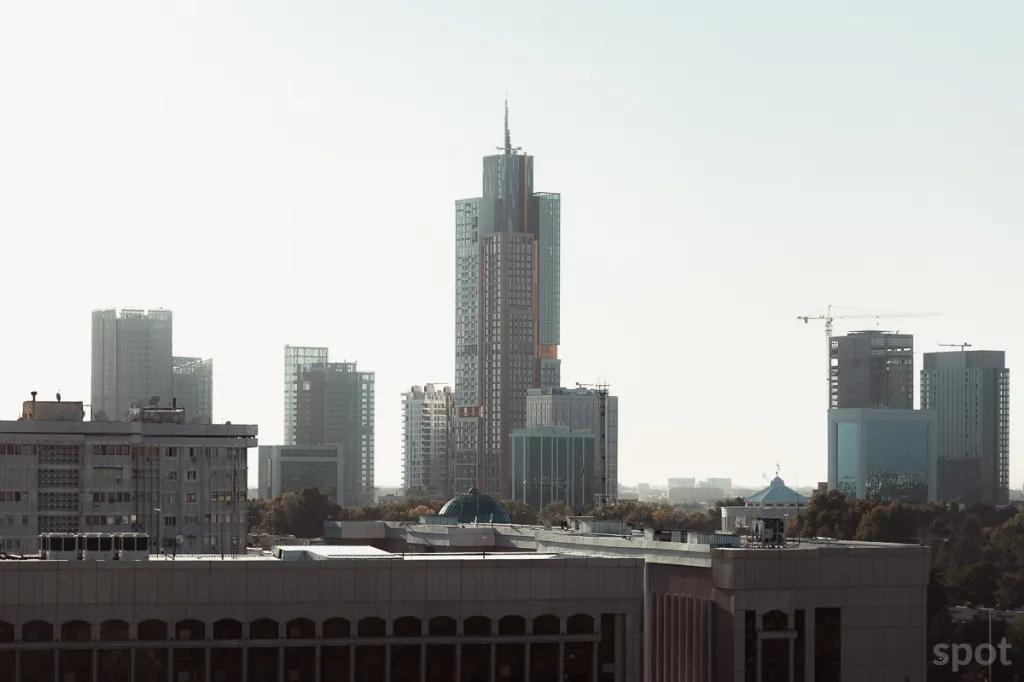
Uzbekistan's real estate market is at the dawn of its development, but the trend of "buy cheap to sell dear" is already changing. Today, demand is forming for the ability to effectively utilize premises. Why this is important and how to learn to do it is discussed in a column by real estate analyst Denis Sokolov.
Denis Sokolov is a partner and CEO of the international commercial real estate consulting company Commonwealth Partnership Uzbekistan (CMWP), and a member of the Royal Institution of Chartered Surveyors (RICS). In his column "The Language of Real Estate," the expert discusses the structure and characteristics of this market and speculates on its development forecasts.
For centuries, humans have been organizing the space around them: building structures, cultivating land, and constructing roads. Today's urban landmarks and architectural monuments that we admire during our travels are what hundreds of years ago were ordinary marketplaces, administrative buildings, bazaars, residential homes, and so on. Since then, people have learned to build complex structures, skyscrapers, bridges, and airports, but the essence remains the same: human civilization is inextricably linked with real estate.
Today, real estate markets in countries form the basis of wealth for families, nations, and corporations. In developed countries, real estate operations account for 15-20% of GDP, while in Uzbekistan, the contribution of real estate to GDP is currently only 5.4%. This indicates that the industry is on the verge of revolutionary transformations.
We are accustomed to viewing real estate as something foreign, despite encountering it daily. Abroad, it's real estate, mortgages, appraisers, flipping; here, it's simply apartments and houses, primary/secondary markets, and neighborhoods. However, the fact that we don't use specialized terms and concepts does not mean we are fundamentally different from other countries.
In the USA, over 50% of all household assets consist of real estate. The value of all homes and apartments owned by Americans is comparable to the value of all American companies. In Uzbekistan, households also strive to invest in real estate. Approximately 95% of households live in their own homes, and even the weak development of mortgage lending does not hinder the growth of the residential real estate market. In addition to housing, Uzbekistanis invest money in shops and office spaces. But simply investing money is not enough. Premises must benefit the city and generate income for the owner.
And if until now the main motive for investment was to buy cheap to sell dear later, then as the economy and urban environment develop, the ability to effectively utilize premises comes to the forefront. Only real estate that can be used effectively appreciates: quality housing in attractive areas, shops in busy locations, good offices.
To distinguish good real estate from bad, one must understand the language of this industry, be familiar with economic trends, financial schemes, and the credit system. One needs to understand their city, know its secrets, culture, and history.
A city is like a set of "Lego" bricks, representing different types of real estate. There are over 25 different types of retail spaces alone. Unfortunately or fortunately, there is no instruction manual for building a city, which is why each city and each district is unique. Urban Studies, the science of urban development, is now one of the most in-demand fields globally.
Many are surprised why apartments in capital cities are much more expensive than in regional towns. In the UK, the cheapest rent is in the city of Bradford, where renting an apartment costs £500, while in London, a similar apartment would cost four times as much. In the USA, the difference in rental costs between the cheapest city (Wichita, Kansas) and New York is eightfold.
This difference is explained by the fact that a large city is a factory for producing human and financial capital. A city provides opportunities for career development, education, and interaction with interesting people. Therefore, high population density in a city is not a disadvantage but an advantage. A growing urban economy rewards every additional effort handsomely. Additional skills, new knowledge, and diligence in dynamically developing cities lead to faster income growth than in "stagnant" cities.
Well-being depends not only on how much we earn but also on how prudently we manage our money. It is not enough to simply build a stadium. It must constantly operate and bring joy to spectators and money to the treasury. Unfortunately, the opposite is often true. In Brazil, the largest stadium, which cost $900 million to build, was closed a year after its opening because the stadium's attendance, designed for 70,000 spectators, did not exceed 5,000 people. Thus, a wrong decision, an error in economic calculations, led to huge losses for the country.
To learn to drive a car, one must spend several months studying the rules, learning to handle unexpected situations, and predicting the actions of other participants. But life in a modern city is no less complex. A city dweller must know how to earn, save, and spend their money wisely, and an entrepreneur must understand how to provide jobs for their employees, manage risks, and develop the country. Uzbekistan's economy is growing by 6% annually, which is more than twice the global average economic growth. And the wealthier the country becomes, the higher the incomes, the more important it is to properly manage wealth, a lion's share of which is real estate.
We will follow economic news and study foreign experience to make the right decisions, so that our companies develop and our families live better. And by learning to speak the language of real estate, we will easily engage in dialogue with bankers, investors, trading companies, and foreign experts. Ultimately, the city will become more comfortable and attractive for its residents, tourists, and investors.
Source: Gazeta.uz
Photo: Evgeny Sorochin / "Gazeta.uz"