Municipal Governance. Distribution of Social Functions Across Public Authority Levels
"Local self-government is understood as the right and the actual capacity of local authorities to regulate and manage a substantial part of public affairs, under their own responsibility and in the interests of the local population, within the framework of the law."
Source: European Charter of Local Self-Government
The relationship between state and municipal authorities is structured differently across countries. In Uzbekistan, we observe a typical post-Soviet approach where republican authority supersedes regional authority, with subsequent delegation of responsibilities to city (municipal) authorities. Each country has a distinct set of obligations at various levels of governance. For instance, in Denmark, healthcare is solely the responsibility of the national government, while in France, it is exclusively a municipal responsibility. This implies that healthcare expenditures for a city in France will be higher than those in Denmark. The zones of responsibility by country are presented in Table 1.
Country Examples:
United States: Cities like New York and Los Angeles rely on federal and state authorities for funding public transportation systems, housing initiatives, and disaster relief. The distribution of power often depends on political negotiations and budgetary constraints.
Germany: German cities operate within a strong federal structure where the Länder (states) have significant control over education, policing, and infrastructure, often limiting the autonomy of cities.
India: Indian cities are largely dependent on state government financial resources, as they have limited powers to raise taxes.
Table 1: Distribution of Social Functions Across Public Authority Levels (Source: HSE University)
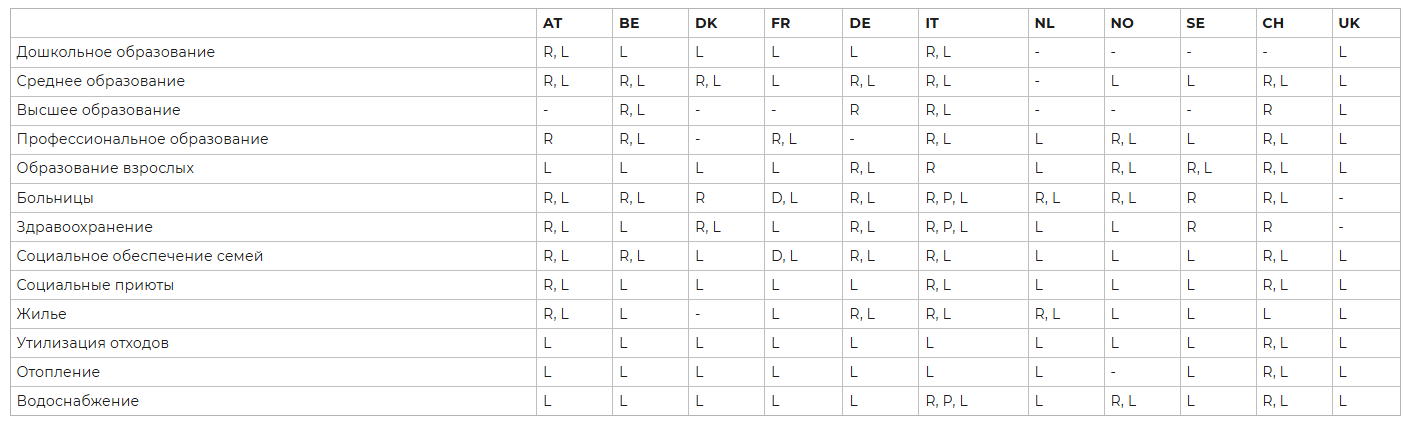
AT — Austria, BE — Belgium, DK — Denmark, FR — France, DE — Germany, IT — Italy, NL — Netherlands, NO — Norway, SE — Sweden, CH — Switzerland, UK — United Kingdom
R — National and Regional Level, L — Local Level, D — Departmental Level (France), P — Provincial Level (Italy).
Revenue Side of the Budget
The revenue side of local budgets can be categorized into several types:
- Tax Revenues
- Non-Tax Revenues
- Grants and Transfers
- Municipal Borrowings (not practiced in the Republic of Uzbekistan)
Tax Revenues
Globally, there are two fundamental systems of local taxation. The first system relies on land and property taxes as the primary sources of tax revenue (Australia, Canada). The second system is based on personal income tax (PIT) (Russia, Germany). The tax base significantly influences municipal behavior. In the first system, the main tasks involve cadastral registration and accounting of land plots. In the second system, the priority is to track local companies and their registered employees. Consequently, in the first case, the focus is on bringing new land into circulation, while in the second case, it is on attracting and employing the maximum number of people. The main taxes in varying proportions in both cases include: profit tax, PIT, mineral extraction tax, property tax for individuals and organizations, land tax, and taxes on goods and services.
The distribution by country is shown in Figure 1.
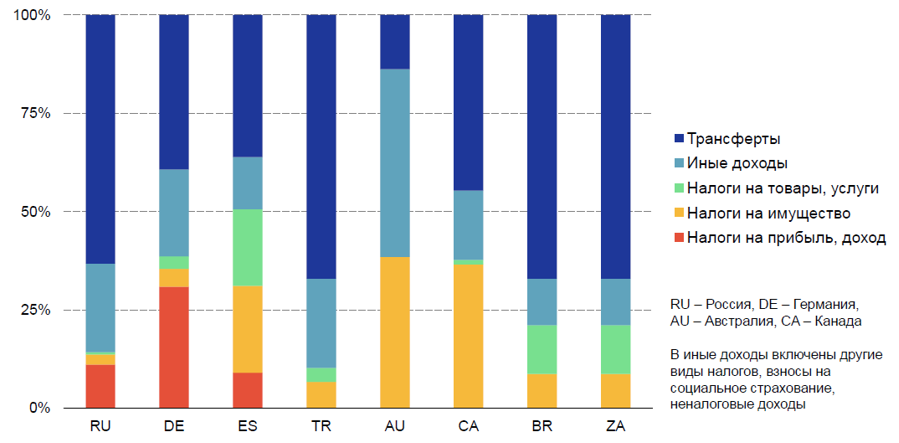
Figure 1: Distribution of Municipal Budget Revenues by Country (Source: HSE University)
Non-Tax Revenues
A significant portion of city revenues comes from non-tax sources. These are divided into the following types:
- Leasing or sale (privatization) of municipal property;
- Provision of paid services in public institutions;
- A share of profits from municipal enterprises;
- Fines and fees.
One of the primary non-tax revenue sources for municipalities involves managing municipal property, which includes land plots and premises (residential and non-residential). It is important to understand that a city's ownership of such property is often dictated by factors such as preferential lease programs for residents or the need to provide office space for internal departments. The maintenance of these premises can be a significant expense, but the sale of, for example, land plots for new construction can become a substantial source of non-tax revenue for development programs.
Transfers
Intergovernmental fiscal equalization is the cornerstone of regional stability. This is due to several factors. Firstly, not every region/municipality possesses valuable resources or fertile land that allows for the development of a strong and stable export-based economy. Secondly, the majority of tax and non-tax revenues in most countries are collected at the national or regional levels. While this allows for the control of unified policies across the country, it also reduces the autonomy of municipalities, making them dependent on national or regional authorities.
Objectives of Transfers
- Balancing revenues and expenditures (vertical balance);
- Eliminating horizontal imbalances (e.g., equalization regarding the presence or absence of resources);
- Ensuring a minimum standard of services (e.g., equalizing doctors' salaries across different municipalities)
- Accounting for externalities [e.g., performing capital city functions (which incur additional expenses)]
Transfers are also divided into types: unearmarked (grants/loans) and earmarked (subsidies and subventions).
Grants serve to balance budgets while maintaining vertical and horizontal equilibrium, but they are not required to be spent on a specific sector.
Subsidies are a means for the government to stimulate a specific economic sector or provide social support to certain population groups.
Subventions, in turn, are funds transferred to a municipality for the performance of regional or national functions, such as financing schools.
Expenditure Side of the Budget
Municipal expenditures are a crucial component of citizens' lives as they directly impact the city. City administrations worldwide typically coordinate several budgets (short-term and long-term). This allows municipalities to formulate more realistic expenditures over an extended period.
Operating Budget (short-term) - expenditures on goods and services to be consumed within one year.
Capital Budget (long-term) - expenditures on equipment and infrastructure expected to be used for more than one year.
Municipal budget expenditures are closely linked to the governance structure and, in particular, to the tasks handled at the municipal level. We can clearly see a division of countries into two groups: the first group (education and healthcare at the national level) and the second group (education and healthcare at the municipal level) (Figure 4). Cross-country comparisons of city budgets cannot be precise for this very reason.