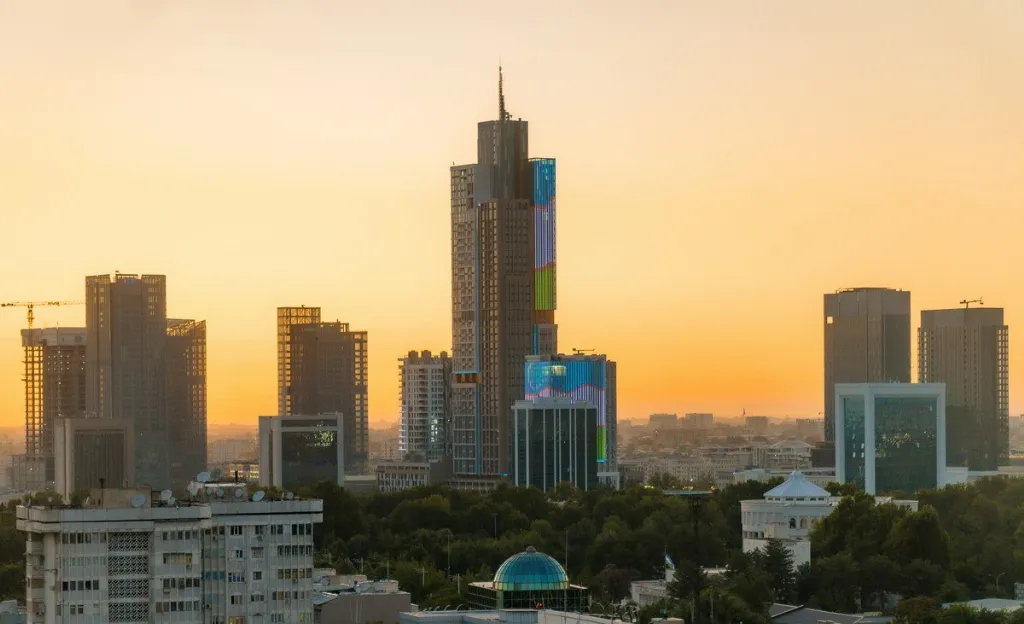
Spot, together with the head of Commonwealth Partnership, Denis Sokolov, reviews what has changed in the real estate market, how prices for housing, offices, and warehouses have evolved, and what to expect for prices next year.
Spot continues its year-end review. This time, Denis Sokolov, General Director of Commonwealth Partnership, shared his insights on the outgoing year in the real estate sector, the observed changes, and expectations for 2025. CMWP analysts also provided an analysis of the retail, office, and warehouse real estate markets.
Residential Real Estate
According to the Center for Economic Research and Reforms (CEIR), housing on the secondary market in Uzbekistan has increased in price by 6.2% over the year. At the same time, apartments in Tashkent have become 1.5% cheaper. The average price per square meter is $1102.
In November, Uzbekistan citizens registered nearly 22,000 real estate sale and purchase agreements, which is 0.8% more than a year earlier.
According to a report by the Central Bank, in the first half of the year, housing in the country cost 28% more than its real price. Compared to the first half of 2023, the cost of apartments in the national currency increased by 44%, and in foreign currency – by 23%.
However, the gap between wage growth and housing prices remains high. In the first 6 months, the average salary grew by 17.7%, while housing prices grew 1.8 times faster than salaries.
This indicates that housing prices in the real estate market are overvalued and may likely be adjusted over time, according to the Central Bank.
At the same time, due to population growth and high density, there is potential for high demand in the real estate market in the future. For instance, the population density in Uzbekistan is 83 people per square kilometer, which is 10 people more than the average in Central Asian and Caucasian countries.
Rental costs in Tashkent continue to decline. According to CEIR, in November, the average rental rate in the capital was $8.3 per square meter, which is 10.7% lower than last year. The Central Bank believes that real estate prices continue to rise despite falling rents because market participants view housing as an investment and expect significant returns from price appreciation rather than rental income.
According to a study by Commonwealth Partnership, the average cost per square meter in Tashkent on the secondary market is $1,216, and in new buildings – $1,251. On average, an apartment with an area of 50-60 sq. m. will cost $82-99 thousand.
The average rental rate, according to the company, for business-class apartments is $17.07, and for premium – $22.66 per sq. m. In terms of average apartment size, rent in the business class costs $1134, and in premium – $1400.
According to CMWP analysts, the Uzbek real estate market has stabilized. The decrease in costs is not due to economic factors but rather a natural correction after demand has been met.
In December, the president approved the introduction of escrow accounts. Testing of the new system is planned in Samarkand, as well as in the Yangikhayot and Sergeli districts of the capital. Experts interviewed by Spot noted that the introduction of escrow accounts, on the one hand, will reduce the risks of fraud and unfinished construction, and on the other hand, may lead to an increase in the cost per square meter.
Offices
In 2024, the Tashkent office real estate market remained stable. The main problem of the market is the shortage of quality office space, which maintains high rental rates.
CMWP analysts note that landlords continue to adhere to a strategy of minimal investment in interior finishing. This approach slows down the office occupancy process, as tenants increasingly prefer ready-to-move-in spaces. Such properties allow for quicker decision-making when choosing spaces, which increases interest in flexible office solutions.
According to the company's research, Class A offices demonstrated relative stability throughout the year. Currently, the total supply in this segment is 128 thousand sq. m. Despite the increase in supply, there is still a shortage of quality spaces with ready-to-use finishes on the market, which maintains high demand for premium offices, especially from international tenants.
By the end of 2024, the vacancy rate in Class A reached 58.2%(74.7 thousand sq. m.), which is 40.6 percentage points higher than in 2023, when this figure was 17.6% (15.1 thousand sq. m.). The main reason for this increase was the commissioning of a significant volume of new spaces. This statistic includes not only ready-to-use premises but also those that are in the process of commissioning, but owners have already started offering them to tenants and concluding agreements.
The average net rental rate (excluding VAT and operating expenses) for 2024 was $34.3 per sq. m. per month, which is 3.6% higher than the 2023 level ($33.1). It is expected that in 2025, the rental rate may slightly decrease due to increasing competition among owners.
In Class B, which is traditionally the most sought-after segment of the market, stable demand is observed. This is supported by the activity of sectors such as banking, IT, FMCG, and telecommunications. The total supply in this class is 344.7 thousand sq. m. As of the end of 2024, the vacancy rate in Class B was 12.7%(43.8 thousand sq. m.). This is 9.3 percentage points higher than last year, when the vacancy rate was 3.5%. This increase is due to the reclassification of some premises from Class A to Class B.
The average rental rate in Class B has increased by 10.1%: from $21.8 per sq. m. per month in 2023 to $24 this year.
Retail
CMWP analysts estimated the volume of quality retail space in Tashkent at 478.5 thousand sq. m., which is 73% more than in 2023.
The key event for the retail real estate market, according to the company's experts, was the opening of Tashkent City Mall with a total area of 200 thousand sq. m., of which 100 thousand sq. m. are available for rent.
In 2024, the range of asking rental rates in shopping centers remained unchanged and varies widely – from $15 to $70 per sq. m. per month. The rental rate depends on the quality of the shopping center, its location in the city, and the specific unit's position within the building.
Price correction
2024 can be called the year when the correction began — the time when prices started to come into some alignment with the real economy.
The real estate market has a certain inertia. This is due to the fact that it involves people who rely on each other when making decisions. If someone has managed to make a profit by reselling an apartment, a trend emerges: “So, I should give it a try too.” This imitation effect can sustain price trends for a long time, even when the market situation begins to change.
A correction in the real estate market is not just a drop in prices; it is a process in which the inertial momentum that has been pushing the market upward begins to subside..
Many buyers focus not on the quality of the housing, but on the possibility of reselling it at a profit. This is no longer a housing market, but a speculation market. People buy apartments not intending to live in them, but only with the aim of reselling them. This encourages developers to build faster, but not always with high quality. Why bother trying if buyers will buy anyway? And when buyers buy only with the expectation that someone will buy this property at a higher price, the market begins to turn into a game with risks, rather than into creating value for people.
Market correction is a process in which speculation begins to give way to real demand and high‑quality projects. When buyers start to realize that simply reselling an apartment at a higher price won’t work anymore, the market begins to return to healthier foundations. This price decline is not necessarily a market downturn, but rather a reduction in expectations. This is the restoration of an adequate price in the market, where developers build not to quickly sell an apartment at a markup, but to create high‑quality properties that will be in demand for long‑term living, not for quick resale.
Thus, the correction in the real estate market is a phenomenon that actually helps stabilize the market. When inflated expectations and speculation fade away, and real demand and housing quality come to the forefront, the market begins to function more healthily. And people start thinking not about how to quickly buy and sell, but about making a truly good choice for the long term. And this is an extremely important point, because it helps to avoid bubbles, which, as we know, ultimately always burst.
Furthermore, segmentation is very important in the real estate market, as it allows wealthy people to buy premium housing, while the middle class can purchase decent housing at reasonable prices.
In previous years, developers, especially smaller ones, tried to build simpler houses but sell them as premium housing. I expect that in the future we will see the emergence of a genuine premium segment with all the attributes (ventilation, a small number of apartments per floor, high‑quality management) priced at $4–5 thousand, and the development of a robust mass‑market segment with a price of $1 thousand per square meter.
At the same time, cheap housing should not be of poor quality. Modern construction technologies, design, and apartment planning make it possible to build comfortable housing without unnecessary costs. I hope that those developers who are more concerned with attractive visuals and marketing promises than with the quality of construction will be the first to face price corrections.
Commercial real estate
Commercial real estate has also undergone changes: rental rates for office and retail spaces have decreased, which has led to an increase in the number of transactions. At the same time, the warehouse real estate market showed the opposite trend — rental rates increased due to the emergence of modern, high‑class facilities, which reflects the high demand for quality premises.
Three banking towers have been put up for sale in Tashkent City. If the sale takes place under market conditions, it will set the so‑called “benchmark” — the expected level of profitability for large real estate assets.
Unfortunately, so far there have been no market transactions involving so‑called “institutional” assets, and international investors continue to observe the market from the sidelines. In global practice, it may take years for the first such transaction to be completed in emerging markets, and for a country to appear on the world’s radar, but then investment activity grows like mountains.
An institutional transaction refers to a transaction involving the involvement of consultants, technical, engineering and legal due diligence, the use of bank financing, and economic assessment. It is important that all participants in the process gain experience in conducting such transactions in a new market, and for new investors, it is very important that they can rely on in‑depth expertise and avoid risks.
An investment transaction in real estate is a process in which a large investor acquires not just a real estate object, but a fully functioning business, buying the rental income stream. In such a transaction, not only the object itself is important, but also the guaranteed receipt of rental income in the future. Imagine the situation: a building housing large international corporations that have signed long‑term lease agreements for 10 years with guarantees from their parent companies. This building immediately becomes an attractive asset for institutional investors.