In a column for Spot, CMWP expert Liliya Yeremenko discusses why identical premises don't work and what developer mistakes ultimately reduce the value of an entire project.
Spot, in collaboration with the commercial real estate consulting company CMWP Uzbekistan, continues its series of publications on retail properties in Uzbekistan. We have already examined what types of retail real estate exist, how rental rates are formed, what affects revenue, and what's wrong with the capital's shopping malls.
In the new article, CMWP expert Liliya Yeremenko analyzes why identical premises fail, how to build strong street retail—from concept and formats to tenant mix—and what developer mistakes ultimately reduce the value of an entire project.
Street retail refers to shops and commercial spaces on the ground floors of buildings with separate entrances from the street (cafes, boutiques, pharmacies, etc.), oriented towards pedestrian traffic.
At first glance, this format seems simpler than a shopping complex, which, as we found, has many nuances—both in creation and management.
But is street retail really as simple as it seems? Why are premises in one project snapped up like "hotcakes," while in another, they remain empty for years? What needs to be done to make streets desirable for retail businesses and comfortable for city dwellers?
If a shopping mall is an interplay of three components: "retailer—developer—customer," then in street retail, the city in all its diversity is added to these three: urban environment, architecture, urban traditions, city authorities, city residents, city image, its history, and development. Therefore, street retail, in any case, touches upon issues of urbanism and city development as a whole.
Let's analyze the specifics of street retail for each of these components.
Street Retail and the City
The main feature of street retail is that it is woven into the urban fabric.
This format does not live off calculated and created traffic, as in shopping malls (where traffic is generated through tenant selection, service, marketing, and infrastructure). Street retail thrives on natural urban life: pedestrians, transport, tourists, residents of nearby buildings and offices, and urban points of attraction.
On the other hand, you must agree, a comfortable urban environment is impossible to imagine without this very street retail—cafes and shops—which are also effective participants in the city's economy.
To achieve a win-win effect for everyone—citizens, businesses, and the city—it is important to consider the key principle: the success of street retail directly depends on human comfort. Street retail favors streets where people enjoy being. If a street has uncomfortable sidewalks, is noisy, unsafe, or simply has nothing to "catch the eye," retail suffers.
This leads to several basic urban planning principles that are generally beneficial not only for businesses but also for citizens.
Firstly, the quality of the pedestrian environment is crucial. The success of street retail is almost always tied to how convenient it is to walk. The city should be designed at a "speed of 5 km/h"—taking into account the real human experience.
The second point to consider is the so-called "human scale." Renowned urbanist and architect Jan Gehl, in his book "Cities for People," explains this principle as follows: the scale of buildings, streets, and public spaces should correspond to humans and their perception.
It is at the level of human impressions and perceptions that we make everyday decisions—whether we want to shop here, whether this residential complex seems premium, whether we would like to live here or not. Such decisions and feelings cannot be imposed "from above." And even if there are attempts to do so, people simply do not support them in practice—they don't come, don't buy, and don't choose such places to live. As a result, people "vote with their feet and wallets."
The third important rule is to design not just square meters, but life scenarios. It is important to combine functions—housing, offices, transport, leisure—and the presence of "anchors" (metro, markets, parks, universities, large offices). Modern street retail is no longer just about shopping, but also about walks, meetings, dining, services, self-care, and quick leisure.
In Tashkent, as in many CIS cities, the principle of comfort has long been ignored—especially during the Soviet and early post-Soviet periods. However, the approach is gradually changing: the master plan is being updated, streets are being reconstructed, and the design code is being approved. These are signals that the city is beginning to systematically work on the quality of the environment.
According to the latest research by our CMWP Uzbekistan team, street retail in Tashkent is developing not only along individual streets but also forming entire clusters around points of attraction. This is an important indicator of improving the quality of the urban environment—meaning conditions for pedestrian traffic and comfortable stays are gradually being created not only on main streets but also in the blocks adjacent to them.
Street Retail and the Retailer
It is important to understand that not every business can operate equally effectively in a street retail format. This depends on the retailer's positioning, the market conditions of retail real estate in the city, and the consumer habits of the audience.
Very broadly generalizing the experience of CIS countries, we can provide the following approximate table with a list of profiles that work in street retail and an indication of premises size.
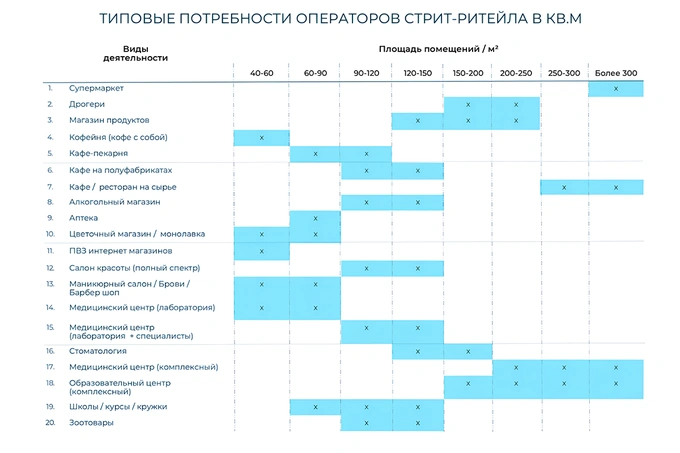 Source: CMWP Uzbekistan
This does not mean that other business profiles do not operate in street retail. The table lists the most common ones. Everything depends on the country, city, and location.
Within the structure of profiles, one feature can be highlighted that works almost everywhere: food service is the "king" of street retail. This feature is also clearly expressed in Tashkent: the share of food service is 28% among street retail operators.
Among other trends in our city, several stable changes can be noted. Clothing and footwear are gradually shifting to shopping malls—this is confirmed by the retailers themselves: when choosing locations for development, shopping complexes are considered first.
At the same time, services—medical, household, beauty, and others—are actively expanding and occupying more space in street retail. This is due to the convenience of locating such functions on the ground floors and within walking distance, as well as the overall growth and development of the economy.
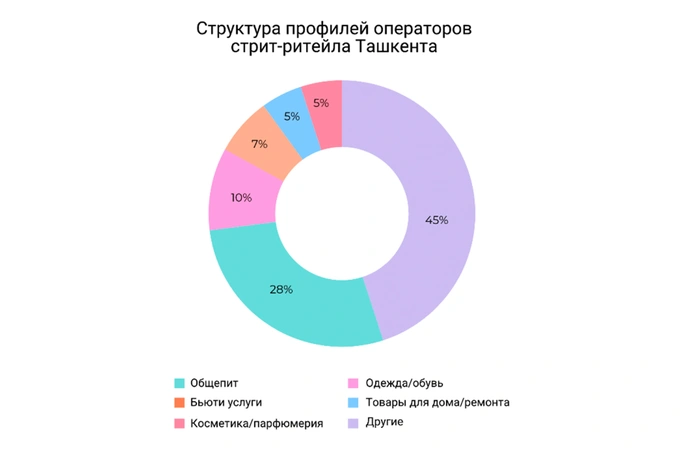
Source: CMWP Uzbekistan
Vacancy in the street retail segment is about 13%, which can be considered a balanced level for the market: both demand and supply are maintained, new players have opportunities to enter, and there is no oversupply of space.
Street Retail and the Developer
The main question for any developer is how to maximize income per square meter. And the answer to this question is usually: "slice" the ground floors and lease them to strong tenants.
However, successful street retail does not arise on its own solely from the availability of commercial premises. It emerges where the developer has initially and consciously designed a retail ecosystem and an urban scenario.
A strong developer thinks not "how to quickly lease all the spaces and lots," but "what model of urban life and consumption am I creating?" In essence, they are selling not premises, but an environment—and this is the foundation of truly strong and profitable projects.
Therefore, it is important to start not with "slicing," but with the concept of the place and answers to basic questions:
- Who comes here?
- Why do they come here?
- When do they come here?
- Why will they stay?
- Why will tenants want to be here?
It is the answers to these questions that form the logic of trade and the basis of commercial infrastructure as a complete product. Without this, the result is just a set of weak premises.
In one of our previous articles, we already discussed what the premises themselves should be like to be convenient for retail and generate income. But this is only part of the task.
It is important to design not only the premises themselves but also the "urban fabric"—active, visually clear facades, convenient and wide sidewalks, barrier-free entrances, as well as strong corner points—sections at the intersections of flows that are more visible and attract more traffic.
It is important to form not just a line of rental spaces, but a complete place. For this, trade alone is not enough. Elements of the urban environment are needed: small squares, waiting areas, terraces, thoughtful lighting, landscaping, and amenities. People don't like "commercial premises," they like spaces where it's pleasant to be.
If a street only provides the function of shopping, its potential is limited. But if a street also offers walks, meetings, coffee, relaxation, and visual pleasure—it begins to live as a complete urban place. And this is what ultimately affects key indicators: rental rates increase, occupancy rises, resident loyalty is formed, and the capitalization of the project as a whole increases.
It is also important to design premises according to the concept. A common developer mistake is to "slice" the entire line into identical lots for the sake of universality. In practice, this leads to a weak tenant mix. Successful street retail requires different types of premises for different functions: only in this way can a complete and consumer-appealing set of tenants be