Green Construction: More Expensive Today, Cheaper Tomorrow
Valentin Kruglikov, Head of Construction Project Management Department, Chief Engineer at CMWP Uzbekistan, explains how the use of green technologies in construction affects the budget and the quality of future building operation.
Globally, interest in energy-efficient "green" technologies is growing.
Most often, when we hear the term "green" technologies, we think of solar power plants, electric vehicles, or waste recycling. However, in construction, an energy-saving approach using renewable energy sources encompasses a much wider range of solutions – from building insulation to the selection of refrigeration systems and automation of engineering processes.
At first glance, implementing "green" technologies seems like an additional burden on the project budget. Indeed, capital costs can be higher. Continuing the topic of optimizing operational costs at the design and capital construction stage, it should be noted that the primary goal of implementing "green" technologies is to reduce future operating expenses by cutting down on electricity, water, and heat consumption. Simultaneously, such solutions contribute to reducing emissions and waste generation.
During project implementation, construction engineers strive to apply a comprehensive set of energy-efficient practices: modern heating, ventilation, and air conditioning systems, energy-saving lighting, and architectural solutions. One of the most non-obvious elements of energy efficiency remains building insulation. High-quality insulation of facades and roofs directly impacts energy consumption.
For example, a high U-Value, which indicates the rate of heat loss through a material or structure, signifies significant heat loss in winter and a tendency for overheating in summer. For Uzbekistan's climate, a low U-value is particularly important, as a substantial portion of electricity is consumed for cooling buildings. High-quality thermal insulation with a low U-Value is most in demand for specialized cold storage facilities, where insulation is applied not only to walls and ceilings but also to floors and building columns to prevent heat from entering from the ground. Quality thermal insulation significantly reduces a building's energy consumption by minimizing heat gains and losses. By maintaining a stable temperature regime, refrigeration equipment operates less intensively and turns on less frequently, leading to reduced electricity consumption.
Another important element of energy efficiency is the use of modern refrigeration and climate control systems.
Industrial refrigeration uses both synthetic and natural substances (refrigerants) in refrigerators, air conditioners, and cooling systems to absorb heat from one place and transfer it to another. Systems using synthetic gases are typically cheaper than those using natural gases during the construction phase. However, natural refrigerants like CO₂, despite a higher initial budget, demonstrate significantly lower operating costs in the long term. Furthermore, CO₂ is considered a more environmentally friendly refrigerant, has minimal impact on the ozone layer, and aligns with the principles of sustainable development and the ESG approach (a global practice where companies consider not only profit but also their impact on the environment, society, and governance quality), ensuring reduced climate impact and compliance with modern environmental requirements.
Depending on climatic conditions, the payback period for solutions using natural refrigerants typically ranges from 5 to 10 years. For Uzbekistan, with its hot climate and high demand on cooling systems, the payback period for such investments is usually estimated at 8–9 years.
Building automation also plays a significant role in reducing energy consumption. BMS (Building Management Systems) allow for the control and optimization of engineering equipment operation. Automated scenarios, monitoring, and precise settings for engineering systems such as ventilation, heating, and air conditioning significantly reduce energy resource consumption. For instance, refrigeration or heating equipment in warehouses can be programmed to minimize load during peak electricity consumption hours by pre-cooling premises while maintaining the required temperature.
Examples of energy-saving solutions are continuously increasing. One of the most notable trends in recent years is the use of solar energy. As energy resource costs rise and sustainability requirements intensify, solar panels are increasingly considered a fundamental element of modern real estate. Developers already assess the future energy consumption of a facility during the design phase and explore possibilities for partially meeting its electricity needs through renewable energy sources.
Recently, we have observed the gradual implementation of heat pumps for greenhouses, water-saving technologies, and advanced water purification systems.
Such energy-saving technologies not only reduce the burden on the country's energy system but also foster a more sustainable and modern urban environment.
The economics of investment and market demands are powerful drivers for the emergence of "green" technologies.
International banks, funds, and investors increasingly require projects to comply with ESG standards. If a facility has a BREEAM, LEED, or EDGE certificate, it becomes easier for investors to assess the project in terms of operating costs and the quality of the facility itself.
Practice shows that the application of "green" technologies increases construction costs by only 5–10% on average. However, these additional investments are recouped within a few years of operation due to reduced resource consumption and operational costs. Certification ensures that the project meets international sustainable development standards and serves as a tool for quality control of decisions made at all stages of the facility's implementation. Not only the performance of the finished building but also the volume of construction waste, emissions, and resource usage during the work process are considered. Having green certification makes a facility more attractive to investors and future tenants.
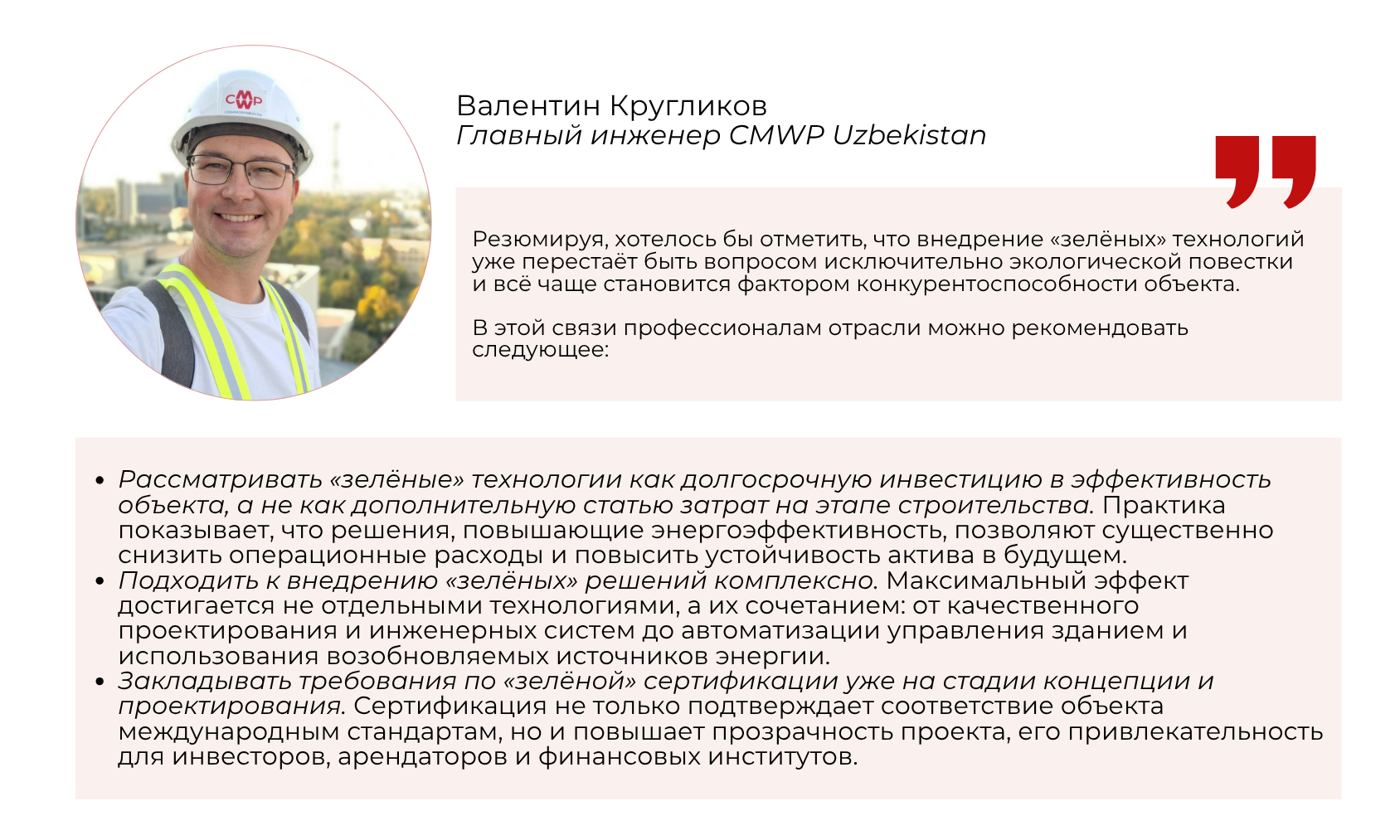
For Uzbekistan, the current stage of market development presents a rare opportunity to shape a new generation of real estate by incorporating the best global practices of sustainable construction. The decisions made by developers and investors today will largely determine the quality, efficiency, and competitiveness of the country's real estate for decades to come.