Analysts at Commonwealth Partnership Uzbekistan have prepared a report analyzing the growing population of the capital and its outpacing urbanization.
Outpacing urbanization and the rapid growth of the capital's population provide grounds to predict that by 2035, the city's population will reach 4 million people, solidifying its position as the largest city in Central Asia, according to Commonwealth Partnership Uzbekistan (CMWP) analysts.
According to the analysts' report, Tashkent's current population density of 68 people/hectare indicates a density comparable to global cities such as London, Hong Kong, and Milan. It is important to note that global cities often have distinct population concentration points, unlike Tashkent, which has a more uniform structure.
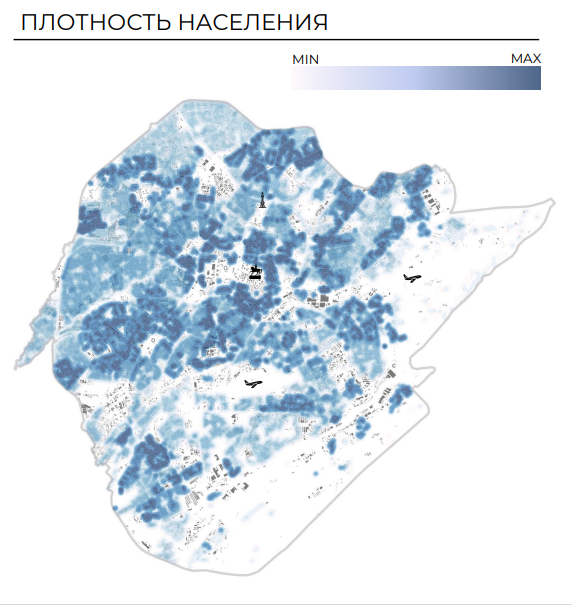
It is worth adding that industrial zones occupy 18.73%, however, approximately 40% of the territories are used inefficiently.
Balanced development of the urban environment should include, among other things, the redevelopment of these territories with an increased share of social and business infrastructure, the CMWP report states.
Furthermore, individual residential buildings occupy over 35% of the city's territory, yet our calculations show that only about 25% of the population lives in them. The majority of the city's population (approximately 62%) resides in medium-rise buildings, which occupy 12.3% of the area.
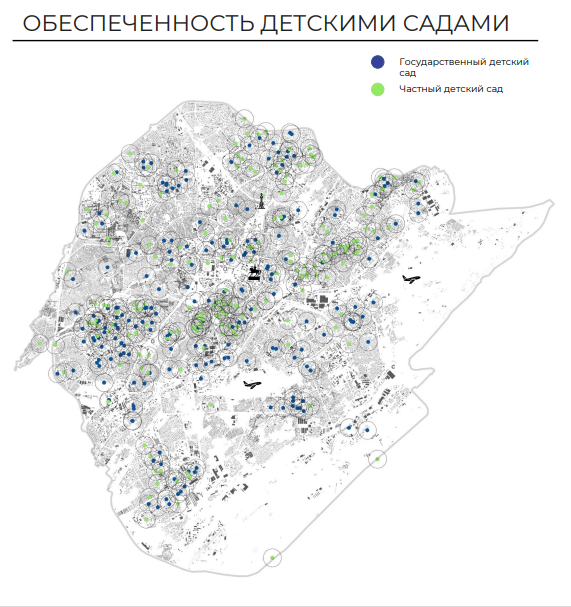
The report also states that 68% of children live within 500 meters of the nearest kindergarten. The lowest provision is observed in individual housing due to the difficulty of opening state institutions. However, private kindergartens are actively developing in such areas. (based on open data). At the same time, CMWP experts note that the city's primary and secondary education system has good coverage: considering private educational institutions, 94% of children live within one kilometer of a school (without considering private schools, the figure remains high – over 90%).
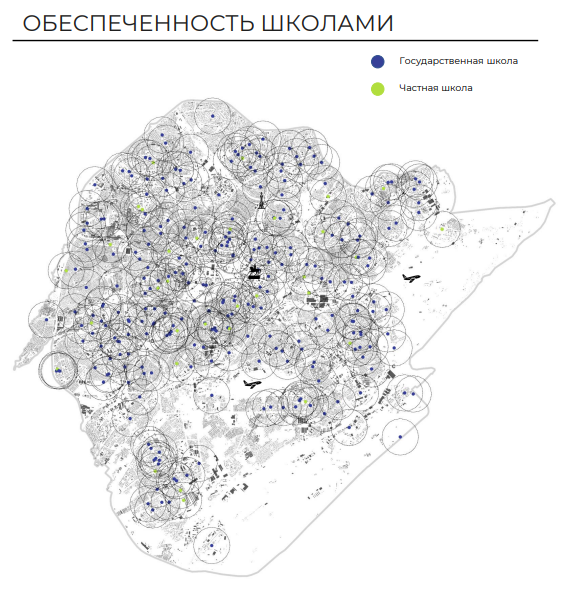
As noted, the situation with kindergartens in the city is noticeably worse than with schools. Only 68% of children live within 500 meters of the nearest kindergarten.
Private kindergartens constitute 45% of all institutions. The problem of accessibility is particularly acute for individual housing within the city limits.
 CMWP forecasts a 120% increase in car ownership by 2035. To manage the load on the transport network, it is necessary to reorganize the city's transport scheme and consistently develop public transport (increase comfort, quality, and popularity, expand the number of routes and services).
A growing population is a driver for the development of the city and its infrastructure. The city's growth requires preparing utility and transport infrastructure for increasing loads. Public-private partnership is one of the important tools in solving the challenges facing the city. To implement PPP, which will spur the development and renewal of infrastructure, it is necessary to reform the regulatory framework and tariff policy, the report emphasizes.
Source: Vzglyad.uz