On February 28, Marina Usenko, Partner and Head of the Hospitality and Tourism Department at Commonwealth Partnership, spoke at the ICCI business program as part of the international exhibition "Construction - UzBuild." Spot presents the key takeaways from her speech.
When it comes to tourism, people usually start by citing statistics on inbound and outbound tourist flows.
Official statistical data for the republic since 2017 indicates a rather explosive growth rate.
In 2019, the flow even reached the mark of 6.7 million people. And despite the fact that in 2020 we all stayed home, 2022 showed a good recovery growth.
Despite the high figures, the question remains: who are these arrivals, and what role do they play in the industry's development?
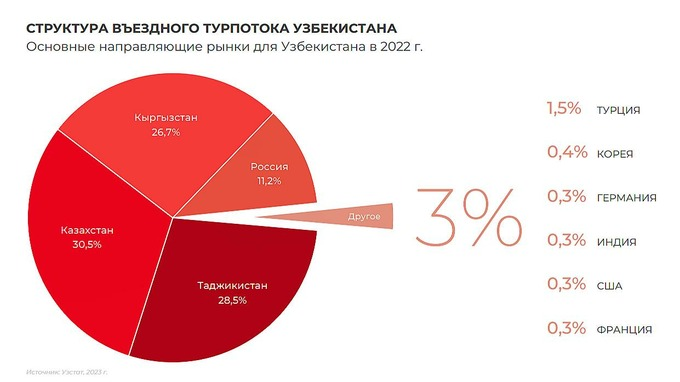
Thus, 97% of all tourists are citizens of neighboring countries: Kyrgyzstan, Kazakhstan, Tajikistan, and Russia. Only the remaining 3% of foreigners come from distant countries.
Citizens of these countries have consistently accounted for 90-95% of arrivals year after year.
 Moreover, when asked by border guards about their purpose of entry, 80% of people, according to our data, respond that they are crossing the border to visit friends and relatives. Consequently, most of them do not stay in hotels.
Another significant portion of those crossing the border cite labor migration or cross-border trade as their purpose of travel, with a relatively small percentage entering the country with tourist intentions.
And the category of consumers who come for personal reasons is extremely sensitive to pricing. They are more likely to opt for individual accommodation (apartments, private houses - ed. Spot). Meanwhile, another category, present in the country on business trips, spends company money and, consequently, has more flexibility with their budget, choosing collective accommodation facilities (hotels, guesthouses, etc. - ed. Spot).
Therefore, tourism-dependent markets have a smaller capacity for further development, which is why they should have more hotels of the so-called tourist class and standard.
Lack of Safety
The two main categories of people who stay in hotels are those who come to see the country and those who are on business trips or for business purposes. In 2019, their number reached a record of almost half a million.
Of these, 97% choose collective accommodation, and 3% opt for private apartments and houses. However, there might be a loophole here, as owners of private properties sometimes operate informally.
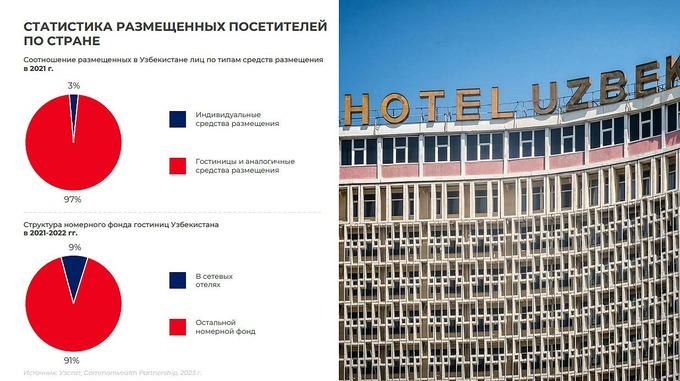 It is important to note that 91% of the nearly 22,000 rooms are a legacy of the Soviet era. Another portion was built in the post-Soviet period, with less than 10% being chain hotel properties.
Chain hotels are distinguished from the general mass because they are typically considered modern quality hotels: they are built to meet the requirements of contemporary travelers and adhere to all quality standards for accommodation, regardless of their star rating.
Moreover, they are absolutely safe for stays, and for global chain operators, safety is a cornerstone. All guests in a hotel must be maximally protected from unforeseen and dangerous situations and natural disasters.
And it is precisely such hotels that are still insufficient in Uzbekistan.
However, not all is bleak, as approximately 3,000 new rooms are expected to be added this year. Of these, 2,000 are being built in Tashkent, and the remaining ones will appear in historical cities – Bukhara and Samarkand.
This indicates where the heart of Uzbekistan's tourism infrastructure beats today.
In this regard, we see two paths: the development of the capital as a center of financial and economic activity, and the development of regions, particularly the Silk Road cities.
Shortage of Affordable Rooms
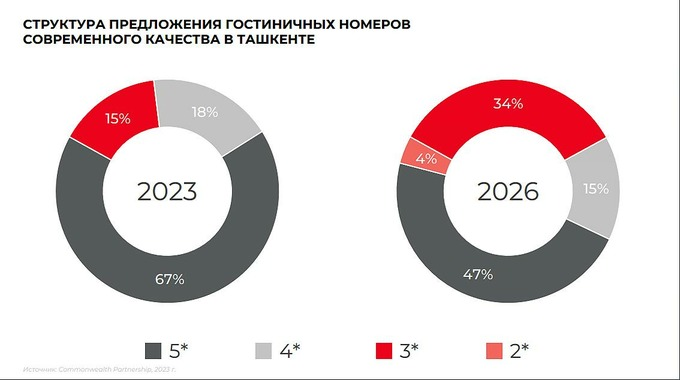
The shortage of three-star hotel rooms is quite understandable and explainable.
New markets like Tashkent tend to develop similarly: first, central areas are developed, where the most expensive hotels appear, and only then does the focus shift to other facilities.
However, the state also bears some responsibility for the shortage of affordable hotels, as until recently, it was the state that financially incentivized developers to build four-star and higher-rated properties.
 Furthermore, rapid construction of affordable hotel spaces in a short period is not enough. Moreover, it carries certain risks – market oversaturation and price wars.
Instead, the structure of demand needs to be changed, which depends not only on developers and investors but also significantly on the will of the state.
First and foremost, it is important to evenly distribute the event calendar throughout the year.
Currently, people visit Tashkent by default either in spring or autumn. During these periods, it is most comfortable for tourists to stay in the country. However, at the same time, business travelers also arrive. Thus, the market faces an oversupply of demand. Meanwhile, the hotel industry experiences significant downtime for a large number of months throughout the year.
There is a solution: firstly, in addition to the business event calendar, a tourist event calendar needs to be created to attract people not only from Monday to Thursday but also on weekends when hotels are idle.
Secondly, consideration should be given to organizing events during the winter and summer seasons.
As an example, one can look at Moscow's experience. This cold and business-oriented city has transformed into a desirable destination for short weekend getaways, particularly for domestic tourists.
State statistics on Uzbekistan's domestic tourist flow indicate that the figure consistently fluctuates between 2 million and 2.5 million citizens year after year.
I believe it is important to capture the attention of this specific tourist flow, to try to attract them through various events, new projects, and activities.
However, to attract citizens from the regions to the capital, the supply of affordable hotels needs to be expanded to ensure a comfortable stay.
Source: Spot.uz