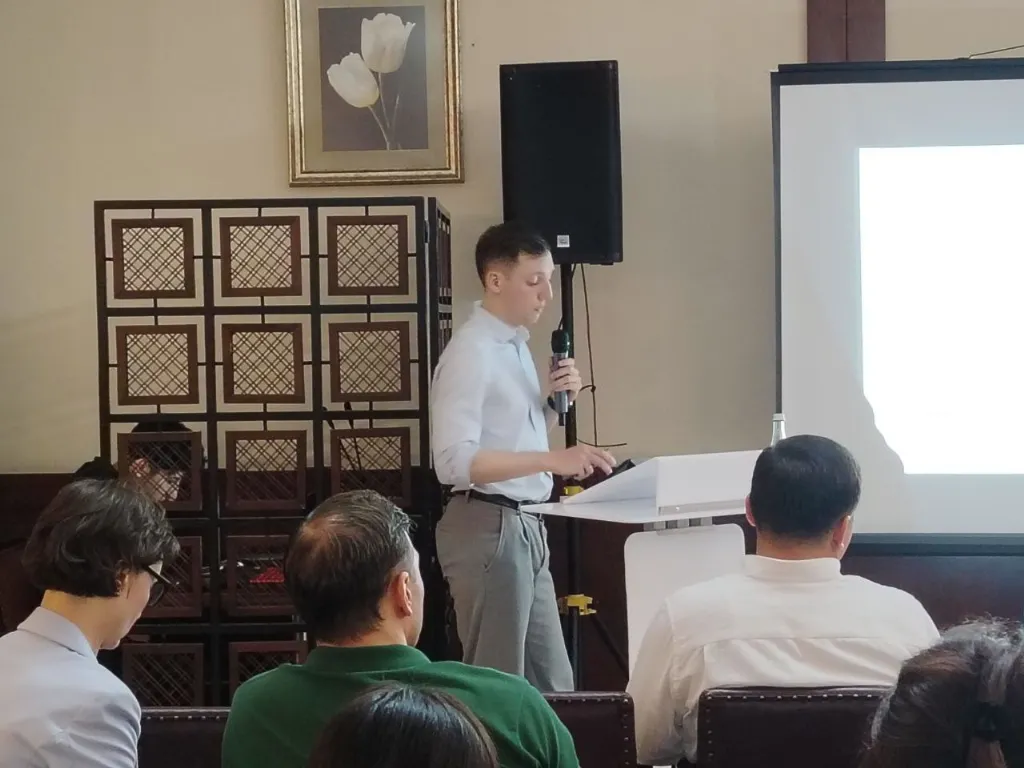
Andrey Shmelkov, Project Director at the Construction Management Department of the consulting company CMWP, discussed the warehouse real estate market in Uzbekistan, the construction of the Balton Trading Asia Class A warehouse, its uniqueness, and compliance with "green" standards.
Until the end of April this year, when the Balton Trading Asia warehouse was built, there were practically no Class A warehouses in Uzbekistan. Andrey Shmelkov, Project Director at the Construction Management Department of the consulting company CMWP, spoke about the local warehouse real estate market, the construction of the Balton Trading Asia warehouse, the project's uniqueness, and its compliance with international standards.
There is often confusion in Uzbekistan regarding the classification of warehouse real estate. How do warehouse premises differ from storage spaces?
Until recently, Uzbekistan practically had no warehouse real estate market that met established international standards. Therefore, there are premises that do not fall into Class A, Class B, or even Class C. Today, unfortunately, most of the warehouse premises used for storage in our market are precisely those that cannot be classified, which is why we call them storage spaces.
What are the main growth drivers in the local warehouse real estate market?
Firstly, it is global trade, within which large international players engage in export and import operations. They have their own well-established business processes built on a specific management system. For example, Balton Trading Asia uses Axelot, one of the most common warehouse management systems in the CIS. These business processes facilitate efficient loading of goods from the warehouse and delivery to the end consumer.
Secondly, it is the population, which is approaching the 40 million mark. Wealth is growing rapidly, and people are consuming more goods, including imported ones. This produce needs to be stored somewhere, and Uzbekistan's warehouse capacity significantly lags not only behind developed countries but also behind other former USSR countries.
Local warehouse operators see market growth, and all logistics companies in the market want new warehouses, understanding that the future lies in this. Balton Trading Asia has taken the lead today by building one of the most modern warehouses in Uzbekistan, which has every chance of becoming a benchmark for all others.
Why did Balton Trading Asia decide to build a Class A warehouse in Uzbekistan?
In my opinion, Balton Trading Asia was the first to grasp the market trend that foreign companies are very sensitive to the concept of compliance, meaning warehouses must meet their requirements. For instance, one of Balton Trading Asia's key partners is Nestle, which has very strict requirements for warehouses where its products are stored. All other operators are picking up on this trend one way or another, hence their desire to build equally high-quality warehouses.
What was previously located on the site of the Balton Trading Asia warehouse?
The site of this warehouse used to be the "Podemnik" plant – an abandoned enterprise built in the 1970s. It was a classic abandoned territory with no development.
What makes this project unique? Firstly, it is an example of redevelopment, where all constructible elements were preserved – columns and roof trusses. From a construction and environmental protection perspective, this is beneficial, as today in Uzbekistan, everything is demolished, and construction begins on a blank slate.
The redevelopment approach to reconstruction and construction at Balton Trading Asia helped save money by utilizing existing structures. It is also correct in terms of corporate social responsibility, considering that all trees on the former plant's territory were preserved with additional landscaping.
How does this warehouse differ from those previously used in the market?
Primarily, it's the 260 kW solar panels installed on the parking lot roof. These panels now almost fully compensate for the warehouse's current energy consumption, which uses only 30 kW from the city's power grid on non-hot days.
The warehouse features industrial floors with a reinforced coating and an in-rack fire suppression system that complies with local requirements and international standards.
Standing seam roofing for industrial buildings was also used, which is resistant to high temperatures and hermetic, eliminating the risk of leaks.
Furthermore, an innovative warehouse management system allows for automatic control of the cooling process. For example, at night, less energy is needed to cool the warehouse, and during the day, we do not draw hot air from outside but use internal air for recirculation, which is cooled by the solar panels. Overall, it is a "smart" warehouse, the likes of which are hard to find in Uzbekistan.
Does the new Balton Trading Asia warehouse comply with "green" standards?
Modern industrial buildings have numerous requirements. The more requirements met, the higher the certificate issued. For example, the Balton Trading Asia warehouse is in the process of obtaining a "green" certificate under the BREEAM standard.
The essence of the "green" building standard is warehouse comfort for people and environmental safety. In our case, requirements for tree preservation, stormwater runoff treatment, rainwater balance, as well as the availability of bicycle parking and transport accessibility, noise and thermal insulation, etc., are taken into account.
A special requirement is public approval. For example, the management of Balton Trading Asia is in contact with the local mahalla, which welcomes the opening of such a warehouse as it creates new jobs and improves the area's surroundings.
Thus, a "green" certificate indicates that the logistics company that built the warehouse has considered nature, employees, and the surrounding community.
Source: Spot.uz