The quality of real estate in Tashkent will significantly increase in the coming years, believes territory development expert Yulia Tokareva. Why expensive housing is built first in the real estate market, how to diversify supply, and whether a mortgage "bubble" can be avoided – in the material by "Gazeta.uz".
The interest of external players in the real estate market of Uzbekistan, and Tashkent in particular, continues to grow, believes Yulia Tokareva, Head of Strategic Consulting Department at Commonwealth Partnership. In the next five to seven years, experts expect significant changes in the quality of real estate. Local and international developers will begin to compete with each other, improving the environment around their properties, offering higher quality materials and aesthetic architecture.
On the stages of real estate market development in Uzbekistan
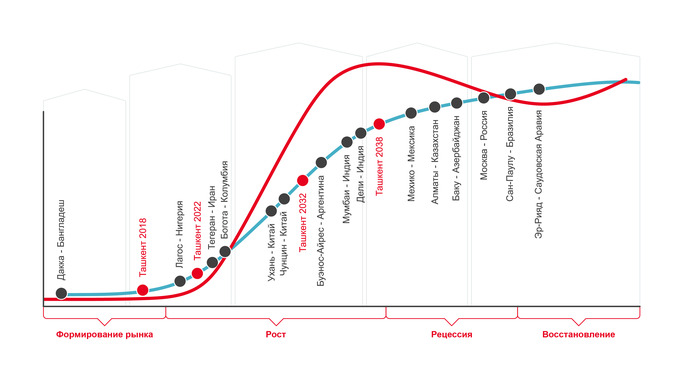
On the market cycle chart, Tashkent is on an upward trend. If we talk about the real estate market, it should be divided into segments. Residential, office, retail, and other types of real estate are at different stages of development.
 Office Real Estate
The office real estate market is in the stage of forming market trends. Currently, the first Class A office projects – a premium segment targeting large international and local companies – are appearing in Uzbekistan. When quality offerings emerge in the market, companies looking for office space will begin to orient themselves towards a new standard: high-quality engineering systems, centralized management, and various services.
With increasing tenant demands for office quality, the market supply will grow, and less quality projects will undergo redevelopment and upgrade their class to maintain interest in their buildings. In other words, one Class A office project will trigger a ripple effect.
Residential Real Estate
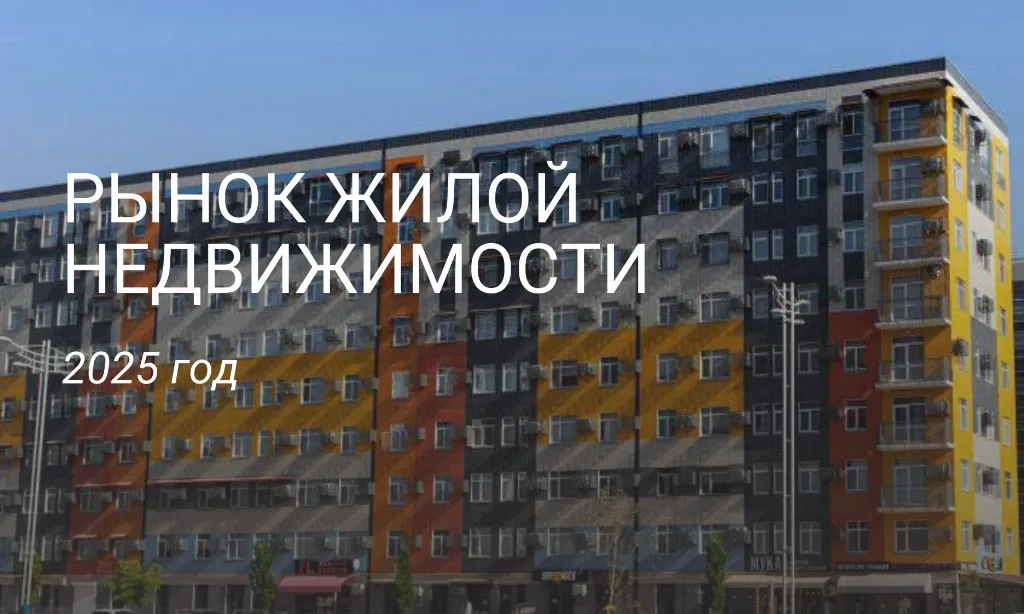
The residential real estate segment in Tashkent is approaching a high saturation point, and competition for consumers is intensifying. Structural changes, where developers compete not on price but on quality, are characteristic of this stage of development.
Warehouse Real Estate
The warehouse real estate market is at an initial level. Historically, many manufacturing companies built warehouses for their own use. It was more convenient for them to build a warehouse themselves than to rent one.
However, internal logistics processes are currently accelerating, so it will gradually become more profitable to rent a warehouse externally rather than build one. There are currently isolated offers for warehouse rentals on the market, but we expect a surge in the next 5-7 years.
Retail Real Estate
The supply in the retail real estate market is outpacing demand. Currently, the supply is formed by residential projects, whose first floors are allocated for retail, and large shopping centers. Demand for large spaces is usually generated by large chain companies – international brands and strong local players, which are not yet numerous in the Uzbek market. Therefore, demand is substituted by small businesses.
This is a natural stage of retail real estate market development that will change. However, it will take some time because international companies need to enter the country. Experts expect that after the opening of the Tashkent City Mall, a number of major international retail chains will appear in the Uzbek market, which will raise visitors' expectations for the quality of leisure and shopping.
Market cycles are endless, and it is important to understand that in 10-15 years, the real estate market in Uzbekistan will reach saturation, followed by stabilization, then a decline, and a new growth cycle. This happens in all markets, but Uzbekistan has everything ahead of it. External players entering the region should plan their projects for more than 10 years, taking into account market cyclicity.
Will middle-income people be able to afford housing?
The situation in the Tashkent market is a classic path of evaluating economic projects from an investor's perspective. For a long time, there was pent-up demand in Tashkent. The propiska (residence permit) system limited the solvent population from the regions in purchasing housing in the capital. Now, these legal restrictions are gone, and this pent-up demand is being realized.
While there were few offers on the market, investors could set high prices. However, the demand from the population for expensive housing is not increasing, and developers are starting to build properties in other price categories.
Real estate prices in the capital may remain stably high, as, for example, in Moscow and other major cities. This is because people view the capital not only as a place to live but also as an investment, for example, for renting out to those coming to the city for work. Housing costs in large cities are steadily rising, as the population always expects high demand for residential real estate.
In other regions of Uzbekistan and Russia, demand for residential real estate is largely driven by people willing to live or move to these areas. This can be the population moving from rural areas or other regions to the city, or people buying property for their children or to improve their living conditions. Investment demand for real estate in these regions is less pronounced, so its prices are growing much slower.
When the pent-up and investment demand for residential real estate is satisfied, a new growth cycle will follow, and complex development projects will emerge, where housing for the mass user will be built. However, for Tashkent to move to this growth cycle, the market must be saturated with the expensive segment.
What will spur the development of the residential real estate market?
Affordable mortgages will give a new impetus to the development of residential real estate. It will multiply the number of buyers who can afford to purchase housing. If more people can afford to buy real estate with long-term payments, developers will expand their product range.
Mortgage development is a matter of state regulation, as a developer can work by investing their own funds, borrowed funds, or buyer funds. And if a buyer cannot afford a long-term mortgage, the supply is formed for those who can purchase real estate with a lump sum payment or installments.
At the same time, the regulator's task is to take measures to avoid a mortgage "bubble" by issuing non-solvent loans and to consider criteria for issuing mortgages.
The problem of mortgage "bubbles" has repeatedly arisen in the markets of other countries. It is avoided through state regulation. For example, in Russia, preferential mortgage lending was introduced a few years ago, which boosted the market: housing demand increased, and developers began to build more. However, when the Central Bank saw the risks of a large number of risky loans appearing, the regulator raised the mortgage rate. Mortgage issuance slowed down because people could not afford the high rate.
Discussions on the introduction of mortgages in Uzbekistan have been ongoing for several years. It should be taken into account that the banking sector also has its stages of development. Therefore, the issue of mortgage lending is addressed not so much to the market as to the overall state policy and economy, which ultimately descend to the user level. And state policy is formed from a grand national idea, which is shaped by the government.
Commonwealth Partnership is an international group of companies that advises businesses and government structures on territory development. It has been operating in Uzbekistan since 2018. During this time, it has implemented 16 projects, including the development of the commercial concept for Tashkent City, recommendations for the industrial and warehouse zone project in Samarkand, and the concept for the construction of Seoul Mun, among others.
Source: Gazeta.uz
Photo: Evgeny Soročin / "Gazeta.uz"